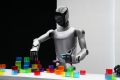
▲Products from 14 robotics developers around the world working with NVIDIA are lined up.
Development in Canada, Germany, Norway and Israel
Expectations for manufacturing process cooperation, 1 billion euro order, etc.↑
The United States is the leading country in robotics development, with advanced humanoid robot prototypes and releases from companies such as Tesla and Boston Dynamics surprising the public with their performance demonstrations. Not to be outdone, many Chinese companies are spurring the development of robotics products by collaborating with Nvidia.
Among the 14 humanoid robotics companies introduced by NVIDIA, we introduce leading American and Chinese companies, followed by products from four non-American and Chinese humanoid robotics companies.
■ Canadian Sanctuary AI 'Phoenix', Differentiating Tactile Sensing 
▲Sanctuary AI 7th generation humanoid robot Phoenix / (Image: Sanctuary AI homepage)
Sanctuary AI is a Vancouver, Canada-based startup founded in 2018.It is the most active and successful company among the companies to be introduced in Z. It commercially distributed the 5th generation robot in 2023, and following the release of the 6th generation Phoenix, it unveiled the 7th generation in April of last year.
Phoenix is 173cm tall, weighs 70kg, and can carry up to 25kg. It can walk at a speed of up to 1.3m/s and has 20 degrees of freedom and haptic technology that mimics the sense of touch for operability. It is known to cost around 40,000 dollars (about 57 million won in Korean currency).
The major improvements in the 7th generation include: △increased operating time, △reduced manufacturing costs due to reduced raw material costs, △extended range of motion of the wrist, hand, and elbow, △improved durability of the robot hand, △miniaturized hydraulics, △improved visual and tactile sensing, and △shortening of automation of new tasks.
Last April, Sanctuary AI announced a strategic partnership with global auto parts supplier Magna to develop general-purpose AI robots to be deployed in automotive manufacturing processes, and is collaborating with Microsoft, Nvidia, and others on the development of humanoids.
In December, when unveiling the next-generation tactile sensor technology, it was emphasized that robots need human-level 'dexterity' to perform high value-added tasks in the workplace. We focus on developing sensitive and durable sensors at low manufacturing costs.
“Our goal is to achieve human-level grip approach using differentiated hydraulic hand actuation technology and advanced sensing,” said Sanctuary AI CEO James Wells.
■ Germany's Neura Robotics '4NE-1' Secures 1 Billion Euro Order 
▲Neura Robotics 4NE-1 / (Photo: Neura Robotics website)
Germany's humanoid robot 4NE-1 is 180cm tall, weighs 80kg, can carry up to 15kg, and moves at a speed of 0.83m/s. The robot arm parts are interchangeable, and its features include △3D vision function △Neura AI API △tactile sensing △non-contact human detection.
According to foreign media, the price will be set between 20,000 and 40,000 euros (about 30 to 60 million won), and production is expected to begin in 2025.
NEURA Robotics announced on the 15th that it had secured 120 million euros (approximately 179.7 billion won) in Series B investment. Since its establishment in 2019, it has been leading the development of humanoid robots in Germany, securing orders worth 1 billion euros (about 1.5 trillion won) with 300 employees.
“Cognitive robotics is set to become bigger than the smartphone,” said David Leger, CEO of Neura Robotics. “As Germany’s only humanoid robotics company, this investment is a testament to our investors’ confidence in our team and in our ability to pioneer advanced robotics in Europe.”
■ Norway 1X 'Neo' aims to develop home robots ▲ (Right) 1X humanoid robot 'Neo' / (Photo: 1X homepage)
Norwegian humanoid robotics company 1X Technologies unveiled the NEO Beta, a bipedal humanoid prototype designed for home use, in August last year. The company said the NEO Beta was a milestone in the transition from conceptual development of humanoids to introducing them into consumer homes.
Neo is designed to be mass-produced in a Norwegian factory, and is said to be about 168cm tall and weigh 25kg, which is relatively light compared to other robots. Other specifications have not yet been released. The robot can be remotely controlled via a VR device.
Building on its previous developments with the wheeled robot EVE, 1X is developing Neo Beta with an eye toward commercial robots entering the home market. 1X aims to create a real-world robot workforce with safe, smart humanoid robots that work alongside humans.
1X secured $100 million in Series B investment, and has been showing experimental moves, such as uploading a video of a home cooking competition with Neo Beta and an American YouTuber in November last year.
■ Israel MentiRobotics' 'Mentibot', AI Capability Strength 
▲Mentee Robotics 'Menteebot' / (Video: Mentee Robotics homepage)
Developed by Israeli startup Mentee Robotics, founded in 2022, the MenteeBot is 175cm tall, weighs 70kg, can carry up to 25kg, walks at 1.5m/s, has 40 degrees of freedom, and is designed to communicate and understand tasks through LLM.
MentiRobotics announced that it has applied the latest Sim2Real transformation to minimize the gap between simulation and the physical world. MentiRobotics CEO Lior Wolf emphasizes that modular AI is important for developing capable robots.
It is planned to be used in homes and logistics centers, with the goal of supplying it to some customers in the first quarter of 2025. Mentibot can perform complex tasks such as language-based commands, navigation, locomotion, computer vision-based object detection and localization, and scene understanding.