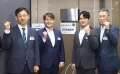
▲A view of the Super Gap Startup exhibition booth in operation at the lobby of Lotte Tower Sky 31 in Jamsil, where the Super Gap Startup (DIPS 1000+) tech conference is held
Outstanding New Industry Startup Award...DeltaX, etc. selected
“Cultivating System Semiconductors: Don’t Just Look at IC Chips”
2024 Fabless and Startup Investment Performance Verification Arrives
As the government rolls up its sleeves to support the development of domestic system semiconductors, a forum has been created for ultra-gap startups to come together to share their achievements and current issues and discuss future development.
The Ministry of SMEs and Startups (hereinafter referred to as the MSS) held the 'Super Gap Startup (DIPS 1000+) Tech Conference' on the 30th at Lotte Tower in Jamsil, bringing together super gap startups in new industries.
This event, which included technology seminars and networking with global experts, large corporations, public institutions, and VCs, is a public-private joint project that the Ministry of SMEs and Startups plans to support with more than 2 trillion won over 5 years to foster more than 1,000 deep-tech startups in 10 new industrial fields that will lead the future of the national economy starting this year.
This year, 295 companies have been selected and are currently receiving support, and this tech conference has become a venue for professionals from various fields to share this year's business performance and future vision, and for startups to interact with each other.
Director Lim Jeong-wook said, “New industry startups are leading the global digital economy and are developing technology and industry. He said, “We plan to actively pursue expanding the inflow of private capital into the venture investment market, strengthening support for overseas expansion, and open innovation so that we can grow into a unicorn that will lead the global startup powerhouse.”
■ Outstanding New Industry Startup Award 
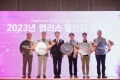
▲ Status of Reward Startups (Source: Ministry of SMEs and Startups)
Among the deep-tech startups in the new industry sector, 10 companies with excellent performance reflecting indicators such as sales, investment performance, and employment this year were selected and awarded the Minister's Award.
The award-winning companies include 10 companies: DeltaX, TiumBio, Greenergy, MachinaRocks, Irop, IntuCore Technology, GenomeInsight Technology, NT Corporation, MorphingEye, and Infludio.
Delta X is an award-winning company in the future mobility field, and was awarded this award for its autonomous driving electric mobility safety support system for the socially vulnerable that combines artificial intelligence vision technology.
DeltaX is known to be working with various global companies and conducting development cooperation projects with domestic and foreign automobile OEMs with the goal of going public in 2025, and is known to be seeking to attract global talent by promoting the establishment of branches in IITs in India and other places.
■ SIPC, Discussion of the Present and Future of System Semiconductors
ht: 338px;" />
▲From left, Lee Hyuk-jae, Director of Seoul National University System Semiconductor Industry Promotion Center, Lee Gyu-bok, Vice President of Korea Electronics Technology Institute, Jeon Jin-won, Vice President of We Ventures, Park Jae-hong, CEO of Boss Semiconductor, and Kim Yang-paeng, Ph.D., Industrial Research Institute
This afternoon, the Seoul National University System Semiconductor Industry Promotion Center held a panel discussion with experts from fabless companies, VCs, and various fields to share current issues in the domestic system semiconductor industry and seek future development strategies.
Lee Gyu-bok, vice president of the Korea Electronics Technology Institute, said, “Korea’s share of the system semiconductor market has recently risen to 3.3%,” and compared to the past when it was in the 1% range, it seems that the efforts to develop system semiconductors have paid off. However, the vice president said, “3.3% out of the total 70% is still a disappointing level,” and expressed hope for the development of the domestic semiconductor industry.
He predicted that the agenda that will sweep the system semiconductor market in the future will include the rise of advanced packaging technology, AI semiconductors and the cloud, and future car semiconductors, and advised that “there are 4-5 key domestic AI semiconductor companies, and it would be good if they could capture the market by entering niches or edges.”
In particular, he emphasized that “system semiconductors should be viewed and approached as an industry, not as a simple IC chip,” and pointed out that the government should draw a picture of developing and cooperating with the ecosystem by looking at the entire industry, such as UAM, aviation, and satellites.
Park Jae-hong, CEO of Boss Semiconductor, also agreed, saying, “The Chinese government does provide direct support to fabless companies, but more than anything, it also provides support to companies that seek out and use domestic fabless products,” and confessed that domestic fabless companies do not have many opportunities to sell their products.
As fabless products are released to the market, sold, and used, customer feedback creates a virtuous cycle of development. CEO Park expressed his expectation, saying, “If the government provides incentives such as tax support to customers who use fabless products, this will be a great opportunity for the development of fabless technology.”
■ System Semiconductor Outlook for 2024 
▲ Lee
Gyu-bok, Vice President of the Korea Electronics Technology Institute, conducting a seminar Although there has been continuous and large investment in the semiconductor market to date, the funds invested in the system semiconductor market are not free.
Jeon Jin-won, Vice President of We Ventures, said, “The topic for next year will be that companies that have received investment will have to show and prove themselves once they move on to Series B,” and it is expected that startup companies will have to be able to clearly present indicators of their progress, such as performance and achievements, for the many investments made this year.
“Next year, investors will closely examine performance and achievements, and they will likely approach investments more cautiously than this year,” said the former vice president, suggesting that a sifting through fabless companies will begin.
Vice President Lee Gyu-bok said, “It is not yet confirmed, but there is talk that next year’s outlook for the semiconductor business will be mainly toward companies taking the lead in finding partners and conducting business,” and in terms of the field, he said, “If there is significant investment and technological input in areas such as AI semiconductors and server semiconductors, the Ministry of Science and ICT will drive them and provide many opportunities.”r />
Although there has been a significant cut in the R&D budget, the semiconductor sector has seen a significant increase in new budgets and many new projects are being planned, so it is predicted that new projects and budget allocations will be made in the first half of next year.