인피니언 Dec
반도체 AI 보안 인더스트리 4.0 SDV 스마트 IoT 컴퓨터 통신 특수 가스 소재 및 장비 유통 e4ds plus

[모빌리티 그랑프리] Changing the car body, wireless charging, and future electric vehicle technology are just around the corner.

기사입력2024.04.25 16:47

Kia showcases PBV miniature and upper body swap demos, discusses easy-swap stations
Witz Unveils Wireless Charging Technology to be Powered by Torres EVX-Based Electric Pickup Vehicles

At the EVS (Electric Vehicle Symposium & Exhibition), which returned to Korea after nine years, a large number of technologies and products that provide a glimpse into the future of electric vehicles, such as PBV, wireless charging, and simulation, were exhibited.

Now in its 37th year, EVS is the premier showcase for the innovative future of industry and the longest-running global representative event. It will be held at COEX Hall C from April 23rd to 26th.

This year's EVS37 will be attended by a large number of companies related to electric vehicles and future mobility, including Tektronix, Moray, and Vector Korea. Presentations will also be given by various companies and organizations, including Hyundai Motor Company, KAIST, and Yonsei University.

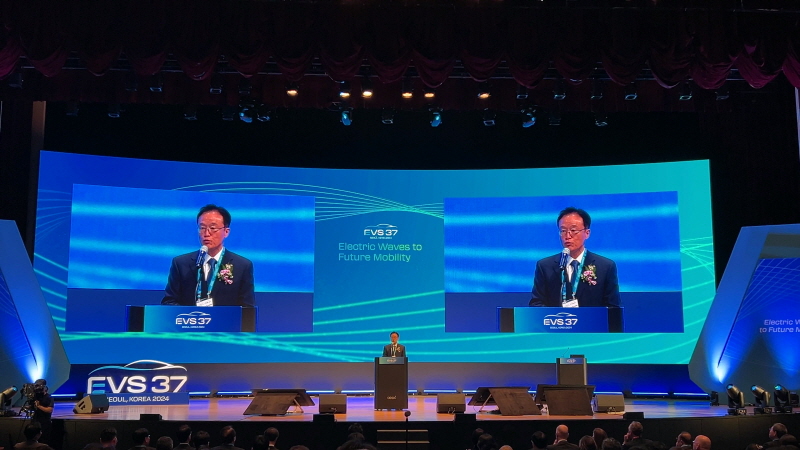
▲Seonwoo Myung-ho, EVS37 Chairman


“EVS is a place to provide insights into the future mobility industry through presentations on the latest trends by industry and academic leaders from around the world and various networking programs,” said Seonwoo Myung-ho, Chairman of EVS37 (37th EVS). “As the EV revolution continues to evolve at an ever-increasing pace, EVS37 is an important point of contact for exchanging ideas and providing the latest EV innovations.”“It will play a role,” he said at the opening ceremony.

Minister of Environment Han Wha-jin


Minister of Environment Han Wha-jin said in his congratulatory address, “As carbon neutrality in response to the climate crisis has become established as a new international order, a consensus has been formed that the transition from internal combustion engine vehicles to electric vehicles is no longer an option but a necessity.” He added, “Electric vehicles, which were once the exclusive domain of a small number of early adopters, have emerged as an alternative to internal combustion engine vehicles that everyone considers at least once before purchasing a car.”

Minister Lee stated, “The electric vehicle industry has shown a steady growth so far, but recently, demand for electric vehicles has shown signs of a slight decline.” He added, “The electric vehicle industry has once again been put to the test, and I believe the answer lies in technological innovation to advance to the next level.”

Hyundai Motor Group displayed a miniature of Kia's PBV, which attracted attention at CES in Las Vegas last January, and Easy Swap, its upper body swapping technology.


Easy Swap is a technology that replaces modules except the driver's seat depending on the PBV's purpose, and it uses magnets andThe variable section is easily separated and mounted through hybrid coupling technology that rotates and engages the fixed structure.

At CES 2024, Kia redefined the concept of PBV as 'Platform Beyond Vehicle.'

The key is to provide new business and lifestyle opportunities through customized designs with freedom and flexibility, as well as an efficient in-vehicle experience through innovative space utilization.

Based on this vision, Kia has unveiled a step-by-step PBV roadmap that includes building a PBV lineup that progresses from midsize to large to small, and bespoke production.

Kia will launch its first mid-size PBV, the PV5, in 2025 and launch its PBV business in earnest.

It will be equipped with a conversion function that allows for the replacement of various life modules depending on the purpose of use, such as vehicle calling, delivery, and utility, and plans to strengthen the connectivity between SDV and external data such as routes and information, enabling the simultaneous operation of multiple vehicles.

At the EVS37 booth, a Hyundai Motor Group representative responded to a reporter's question about the PBV target market and upper body replacement equipment by saying that the company could target not only B2B but also B2C, and that it was also discussing building its own station to ease the burden on consumers regarding upper body replacement equipment.

Upperbody also said that they will try to satisfy the needs of consumers in various ways such as purchasing and renting, but that nothing has been decided on perfectly and that they are carefully discussing it internally.

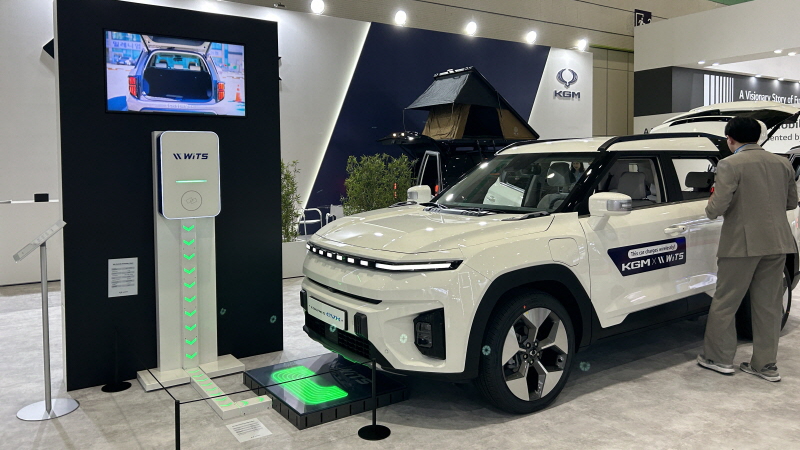
At the KG Mobility booth, Witz showcased its wireless charging technology, which it plans to equip its Torres EVX-based electric pickup vehicle.
gn: center;">


The current wired charging method involves connecting the cable directly, so there is a risk of electric shock due to wear and tear on the contact area or damage to the cable caused by foreign substances. However, wireless charging has the advantage of reducing the risk of electric shock because the cable is discharged, so there are no exposed wires.

Wireless charging hardware consists of a 'ground pad' that is installed on the floor and transmits wireless power (transmitter) and a 'car pad' that is installed on the underside of the car and receives electromagnetic fields (receiver).

This is a form of generating a magnetic field through a coil in the transmitter, and collecting energy by inducing a current by receiving this magnetic field in the receiver.

There is a problem that if a metal object or living organism enters between the transmitter and receiver, which are located far apart, an electric current may be induced, which may cause a fire or burns.

Additionally, there is a clear weakness in that if the two devices are not positioned correctly and are charged crookedly, the efficiency drops sharply.

An official we met in front of the Witz charger responded to our reporter's questions about these issues by saying, "We are preventing danger with technology that immediately stops charging if metal or living things are detected during charging."

He continued, “It is inevitable that the charging efficiency will decrease if the transmitter and receiver are misaligned due to the nature of wireless charging.” He continued, “Several methods are being researched and developed, such as a method of accurately identifying the locations of the two devices by installing sensors, and Witz is adopting a method of sending a signal to the vehicle when it is accurately located through communication.”; he said.