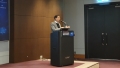
▲ Na Hyeon-sik, manager of Nozomi Networks, is giving a presentation on the topic of ‘Digital transformation strategy for manufacturing using AI and cloud’ at the ‘2025 e4ds IIoT Innovation DAY_part 2’ event.
Digitizing Legacy Equipment a Key Target for Cyber Threats
Implementing a 4-step strategy including asset recognition and vulnerability assessment
“We share the perception that cybersecurity is business security, and all companies must actively strengthen security.”
At the '2025 e4ds IIoT Innovation DAY_part 2' event held on the 12th, Na Hyun-sik, manager of Nozomi Networks, gave a presentation on the topic of 'Manufacturing Digital Transformation Strategy Using AI and Cloud', and stated that as cyber threats related to OT/IoT increase, cyber risk is not an IT issue but a business risk, and a response to it is urgent.
According to Manager Na Hyeon-sik, digital transformation has become an essential task for companies, and building a smart environment using cutting-edge technology is no longer a matter of choice but of survival.
On the other hand, as digital transformation accelerates, cyber threats and security issues are also increasing in complexity and importance. In this situation, companies are seeking strategies and solutions to effectively respond to it.
One of the challenges that companies face in the digitalization process is the digitalization of legacy equipment. In situations where it is impossible to completely replace existing major facilities and infrastructure, the challenge of maintaining legacy equipment while also carrying out digitalization arises.
In particular, vulnerabilities in older operating systems and network-connected equipment can be prime targets for cyber threats.
Digital transformation also has the unintended consequence of expanding the cyberattack surface.
The introduction of AI and Internet of Things (IoT) technologies has enabled automation and remote operation, but this has also increased exposure to cyber threats.
A recent report found that even for large global enterprises with hyper-connected environments, managing cyber threats is emerging as a top priority.
Accordingly, Manager Na Hyeon-sik proposed the following four-step strategy for effective cyber threat management.
The first asset recognition step involves making a list of key equipment and facilities within the organization and analyzing how they are connected. This allows you to identify early risk factors.
Second, in the vulnerability assessment stage, security vulnerabilities of the identified assets are derived and the severity and priority of the vulnerabilities are assessed. Recent AI-based solutions enable this process to be performed more effectively than existing manual or Excel-based data analysis.
Third, in the response phase, measures are taken to resolve identified vulnerabilities. For example, many vulnerabilities can be addressed by upgrading key software or strengthening the encryption level of the communication network.
Fourth, in the monitoring phase, we continuously monitor risks, monitor the emergence of new threats, and build a system to quickly respond to the changing security environment.
Manager Na Hyun-sik said, “Cyber threats are no longer just a problem for the IT department, but have become a business issue directly related to the survival of the entire company. Failure of important equipment or security incidents can lead to a major crisis that goes beyond simple technical issues and can affect the entire operation of the company.”
He also said, “We share the perception that cybersecurity is business security, and all companies should actively strengthen security,” adding, “In particular, efficient security management using AI and automation solutions is emerging as a key task in the digital transformation era.”